There are a few key messages relating to Hindu beliefs, values, and rituals that continuously come up throughout my research of Hinduism in memes. Some of these messages restate widely known stereotypes regarding Hinduism. They use a sarcastic tone to poke fun at some of the Hindu traditions, values, and beliefs in order to educate viewers unfamiliar with Hinduism and to relate to currently practicing Hindus. Some commonly used stereotypes we have seen in previous blogs include the stereotype of Hindus considering cows to be gods, arranged marriages, their belief in reincarnation, the use of Bindis, and the practice of Diwali. Two sample memes are listed below that feature some of these common assumptions or labels put on Hinduism through these memes.
1. 
2. 
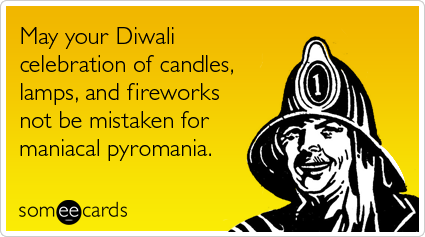
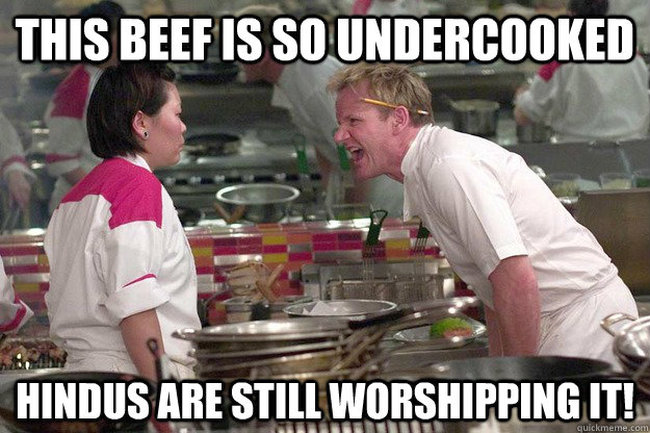
Meme #1 illustrates the stereotype that Hindus praise cows. It could be considered comedic to both Hindus and non Hindus. It also would educate a non Hindu that didn't otherwise know that Hindus highly respect cows. Meme #2 uses a comedic strategy to comment on the tradition of Diwali.In a way, this meme is making fun of Diwali. This meme would be appealing to someone of the Hindu faith because they know what Diwali is and can understand the truth to this meme. Someone that is not familiar with Diwali might be confused by this meme, but would hopefully lead to them further researching the tradition. The representations of these beliefs and traditions align very similarly with the official beliefs of the Hindu tradition. With every meme and stereotype, comes some truth and some misrepresentation. Meme #1 is a great example of how these memes match the official religious beliefs of Hinduism. It is true that cows are greatly respected in the Hindu faith for what they provide to the world. They unselfishly give up their needs for the needs of the Hindu people, providing sustenance to all. But, this meme dramatizes this belief. Although Hindus do believe that cows should be cherished and are sacred, they do not praise these animals like they praise God. Memes tend to exaggerate these beliefs normally for dramatic or comedic effect. But, the value does align with Hindu religious beliefs. Meme #2 also aligns with the Diwali official religious ritual. Diwali is the Hindu Festival of Lights where people celebrate for five days and typically set off firecrackers at night. I think most members of the Hindu community can agree that meme #2 does accurately portray the reality of the Diwali celebration. Five days of celebration and fireworks would be very loud and distracting to others. But, the misrepresentation in this meme is that "Diwali is coming with its air and noise pollution". This meme is exaggerating an official religious tradition for comedic effect. As one can see from these memes, there is a lot of truth to these memes. They accurately align with the beliefs and traditions of the Hindu faith, but tend to over dramatize some aspects to please viewers of these memes and to grab their attention.
The article I read this week that greatly helped me to understand how and why Hindus utilize various forms of media was an article written by Stephen Jacobs titled Communicating Hinduism in a Changing Media Context. This article explains that it is important for Hinduism to utilize the media to its advantage because media effects how Hinduism is not only perceived by the public, but how it is practice by the members of its community (Jacobs). Media such as newspapers are important in order to establish Hinduism as an official and active religious community. Other forms of printing such as making religious texts available to people all over the world is needed to promote this religion (Jacobs). Hinduism also utilizes cyber space to reach out to the public. They have a variety of sites with information regarding Hinduism, about specific Hindu religious groups, certain temples, specific services, and they even have online sacred rituals one can perform (Jacobs). The author explains that the use of technology for religious practices is considered an extension of traditional ritual (Jacobs). The article concludes by saying that technology is helping to create and project Hinduism to people all over the world and has aided in Hinduism being considered a "world religion"(Jacobs, 145). After reading this article, one can see how important technology is to Hindus. It contributes in educating others on the religion, spreading the Hindu faith, defining the Hindu identity, and can help fellow Hindus in continuing their practice of the Hindu religion. This article takes me back to the point I made in the previous paragraph, that the values and traditions portrayed in the memes positively align with the official Hindu religion. After reading this article, it seems that Hinduism embraces media like these memes. Even if they do use comedy or exaggeration, as long as the meme accurately portrays the religion and spreads the Hindu identity and faith, it is accepted by the Hindu community.
As I have mentioned earlier in this blog, the stereotypes that are continuously shown in these memes are the stereotype of Hindus considering cows to be gods, arranged marriages, the belief in reincarnation, the use of Bindis, and the practice of Diwali. I think it is very interesting that these beliefs and practices are commonly utilized because they are very specific. I do think they are good values and practices to be taught through memes to non members of the Hindu community because they are central values and practices to the religion.
Works Cited Pictures:
1. http://img.memecdn.com/indian-burn_o_1145666.jpg
2. http://s2.quickmeme.com/img/14/146d80b6eb40d754f52143a4c00dc3a9cf1a73d37369b3aaf867fe13b3001c7f.jpg
Works Cited:
Jacobs, S. B. (2012). Communicating Hinduism in a changing media context. Religion Compass, 6(2), doi:10.1111/j.1749-8171.2011.00333.x